Pests · Mice
Mice
House mice get in through gaps the size of a coin and quickly take over homes, stores, and warehouses. Mice are handled with grain baits, dough baits, wax blocks, and glue traps — the format is chosen for the site and its humidity.

About the pest
A mouse finds its way indoors through an opening of about a centimeter — a vent, a gap around utility lines, a loose-fitting door. Once inside it needs no more than crumbs and access to water, which is why mice turn up even in tidy homes, while in stores and warehouses they settle behind the racking and in back rooms.
The main damage is contamination: food a mouse has touched is no longer fit to eat, and in production and retail that means direct write-offs. A mouse's incisors grow throughout its life, so it gnaws constantly — packaging, insulation, and wiring all suffer.
The protection plan is the same as for rats, adjusted for size: grain baits and dough baits in dry places, wax blocks in damp ones, and glue traps where baits are undesirable — next to food, for example.
- Set bait points more densely than for rats: a mouse feeds within a few meters of its nest.
- Close off access: seal the gaps, fit screens over the vents.
- Keep permanent points at sites with goods turnover — new animals arrive with deliveries.
- Use products strictly according to the instructions on the pack.
Worth knowing
They get in anywhere
Mice squeeze through an opening of about 1 cm — the size of a coin. Inspect utility-line entry points and door thresholds.
Always gnawing
The incisors grow throughout life, so a mouse gnaws constantly: packaging, insulation, cable.
A small radius
They feed within a few meters of the nest — bait points have to be set more densely than for rats.
Contamination beats gnawing
Food with mouse traces means write-offs and findings at inspections, the main loss in retail.
Product categories

Soft baits
Bait works only after a rodent eats it — so this entire category is about palatability. The soft bait smells like food and has the texture rodents expect from food: one feeding, death on day 3–8, and no wariness among the rest of the colony.
Learn more →
Sticky ribbons and glue traps
Where chemicals are entirely off-limits — at a food plant, in a kitchen, or at a childcare facility — mechanical trapping does the work: glue and a food attractant. Not a gram of active ingredient, up to 4 weeks of effectiveness, and a result visible directly on the trap.
Learn more →

Mice — pest control products · 40


Rat Death® No.1 Special Soft Baits, bucket
SKU 2533805

Rat Death® No.1 Special Soft Baits, 100 g
SKU 2533779

Rat Death® No.1 Special Soft Baits, 200 g
SKU 2533792

Rat Death® No.1 Special Soft Baits, stand-up pouch
SKU 2534234

DOXS® Soft Baits for Rats and Mice
SKU 2533636

DOXS® Soft Baits for Rats and Mice, box of 10 baits
SKU 2534299

DOXS® Soft Baits for Rats and Mice, box of 20 baits
SKU 2534312

Rat Death® No.1 Smoked Meat-Flavored Special Soft Baits
SKU 2534156

Rat Death® No.1 Cheese-Flavored Special Soft Baits
SKU 2534169

Rat Death® No.1 Natural Fruit-Flavored Special Soft Baits
SKU 2534182

DOXS® Meat-Flavored Soft Baits for Rats and Mice
SKU 2533610

DOXS® Cheese-Flavored Soft Baits for Rats and Mice
SKU 2533623

DOXS® Dual-Flavor Soft Baits for Rats and Mice, 100 g
SKU 2533584

DOXS® Dual-Flavor Soft Baits for Rats and Mice, 200 g
SKU 2533597

Rat and Mouse Death No.1 Rodent Pellets, 100 g
SKU 2533506

Rat and Mouse Death No.1 Rodent Pellets, 200 g
SKU 2533519

Alligator® Special Soft Baits, 100 g
SKU 2533675

Alligator® Special Soft Baits, 200 g
SKU 2533688

Alligator® Soft Baits for Rats
SKU 2533701

Rat Death® No.1 Special Soft Baits, in bulk
SKU 2533818

Rat Death® No.1 Smoked Meat-Flavored Special Soft Baits, in bulk
SKU 2534195

Rat Death® No.1 Cheese-Flavored Special Soft Baits, in bulk
SKU 2534208

Rat Death® No.1 Natural Fruit-Flavored Special Soft Baits, in bulk
SKU 2534221

Mouse Death™ No.1 Rodent Grain Bait, 100 g
SKU 2533532

Mouse Death™ No.1 Rodent Grain Bait, 200 g
SKU 2533545

Mouse Death™ No.1 Rodent Grain Bait, stand-up pouch
SKU 2533558

DOXS® Grain Bait for Rats and Mice, 100 g
SKU 2533649

DOXS® Grain Bait for Rats and Mice, 200 g
SKU 2533662

Alligator® Rodent Grain Bait, 100 g
SKU 2533714

Alligator® Rodent Grain Bait, 200 g
SKU 2533727

Mouse Death™ No.1 Rodent Grain Bait, in bulk
SKU 2533571

Rat Death® No.1 Rodent Wax Blocks
SKU 2533766

Rat Death® No.1 Glue Trap for Rats and Mice
SKU 2533740

Rat Death® No.1 Glue Trap for Rats and Mice, large pack
SKU 2534247

Rat Death® No.1 Glue Trap for Rats and Mice, extra-large pack
SKU 2534260

DOXS® Glue Trap for Rats and Mice
SKU 2533480

Mouse Death™ No.1 Mouse Glue Trap
SKU 2533493

Rat Death® No.1 Rodent and Insect Trapping Glue
SKU 2533753

DOXS® Rodent and Insect Trapping Glue
SKU 2534286
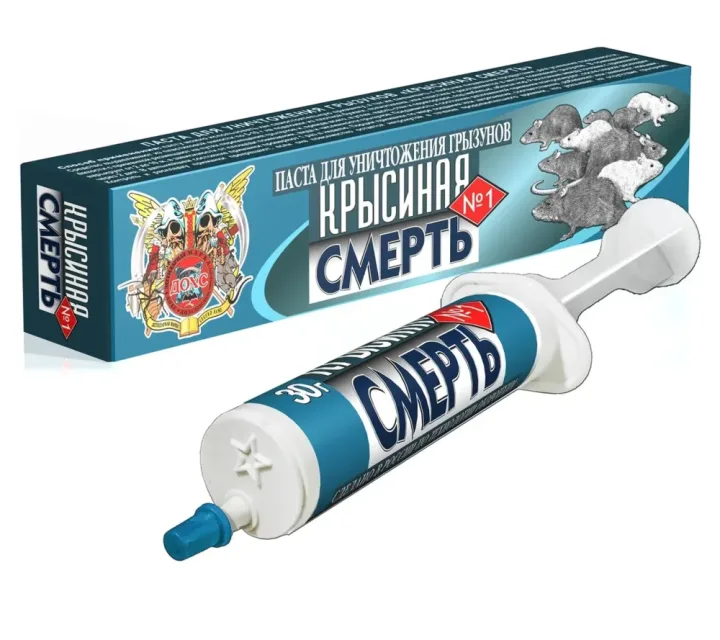
Rat Death® No.1 Rodent Paste Bait
SKU 2533038Wholesale supply of pest control products
We supply distributors, retail chains, and agribusinesses direct from the plant: a complete document package for chains and uninterrupted shipments through the season.
Your own brand of pest control products
We make pest control products under our partners' brands — from formulation to finished packaging on our own lines. Discuss your product with our technologists.